
A round knife should be selected by cutting method, material, edge profile, diameter or sweep, bevel direction, blade material, mounting system, and required finish. This Round Knife Selection Guide distinguishes rotary circular blades from curved carving knives and explains eight practical choices for clean, controlled cutting.
What is a round knife?
Table of Contents
The term round knife has two common meanings. In industrial converting and textile work, it usually means a circular rotary blade that rolls or spins through fabric, film, paper, rubber, foam, or composites. In woodcarving, it can mean a curved-edge carving knife or gouge used to form hollows, petals, branches, grooves, and rounded transitions. The tool category must be identified before any size or edge is chosen.
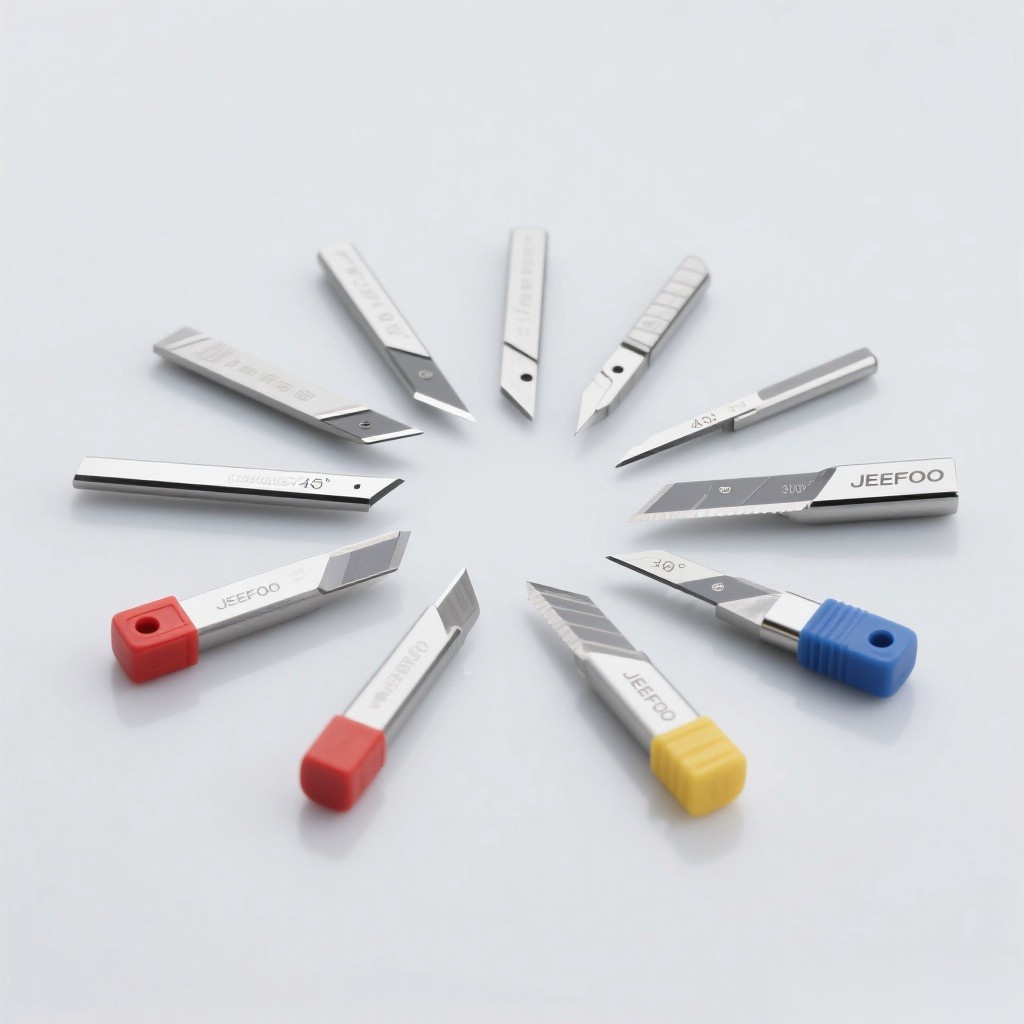
Round Knife Selection Guide: quick comparison
| Type | Best use | Main selection point |
|---|---|---|
| Rotary fabric blade | Textile layers and patterns | Diameter, guard, replaceable blade |
| Industrial slitter blade | Film, paper, foil, laminates | Mounting bore, runout, edge geometry |
| Powered round knife | Stacks of flexible material | Machine compatibility and rated speed |
| Positive-bevel carving knife | Deep hollowing and rough shaping | Bevel orientation and sweep |
| Reverse-bevel carving knife | Controlled surfaces and special access | Back bevel and clearance |
| Bent gouge or spoon knife | Deep recesses and bowls | Curvature, handle clearance, grain direction |
1. Identify the cutting process
The Round Knife Selection Guide starts with the motion. A rotary blade produces a rolling or shearing cut and should be matched to the machine or hand-tool holder. A carving knife removes chips by controlled hand pressure and must match the concave or convex feature. Do not substitute a hand rotary cutter for an industrial powered blade or use a carving gouge as a general-purpose utility knife.
2. Match the edge to the material
- Fabric and leather: a sharp, thin rotary edge reduces pulling and fraying.
- Paper, film, and foil: consistent edge finish and minimal runout support clean slitting.
- Rubber and foam: blade profile, lubrication policy, compression, and support influence distortion.
- Woodcarving: sweep, bevel, grain direction, and edge strength control the cut.
- Abrasive composites: prioritize wear resistance and follow the blade maker’s application data.
The Round Knife Selection Guide treats material thickness and layer count as separate variables. A blade that cuts one thin sheet cleanly may deflect, heat, or wander in a compressed stack.
3. Select diameter, sweep, and curvature
For a rotary blade, diameter affects cutting depth, access, stiffness, and compatibility with the guard and arbor. Use only a diameter listed for the tool or machine. For carving, the sweep describes the curvature: a shallow sweep forms gentle hollows, while a deeper sweep removes material from tighter concave shapes. Bent or spoon profiles reach cavities that a straight shaft cannot access.
4. Choose bevel direction and edge profile
Industrial round blades may use single-bevel, double-bevel, hollow-ground, dished, crush-cut, score-cut, or shear-cut edges. The mating anvil and slitting method determine the correct profile. In carving, a bevel on the outside of the curve is common for gouges, while inside or reverse bevels support specialized control. The Round Knife Selection Guide recommends preserving the factory angle unless the manufacturer specifies a different grind.
5. Compare blade materials and coatings
| Blade material | Strength | Typical consideration |
|---|---|---|
| High-carbon steel | Fine, keen edge | Needs corrosion care |
| Stainless steel | Corrosion resistance | Edge retention varies by grade |
| High-speed steel | Toughness and heat resistance | Useful for demanding industrial cutting |
| Tungsten carbide | Wear resistance | More brittle; requires stable mounting |
| Coated steel | Lower friction or added wear resistance | Coating must suit the material and process |
6. Verify mounting and machine compatibility
- Match outside diameter, bore, keyway, thickness, dish, and rotation direction.
- Confirm arbor condition, clamping faces, guard clearance, and rated speed.
- Check axial and radial runout after mounting.
- Use the specified blade holder, washers, and fastener torque.
- Never exceed the blade or machine maximum RPM.
A dimensionally similar blade is not automatically interchangeable. Small differences in bore, thickness, offset, bevel, or rated speed can produce poor cuts or unsafe operation.
7. Prioritize handling and guarding
Round edges can cause serious injury even when stationary. Disconnect or lock out powered equipment before blade changes, use cut-resistant handling practices appropriate to the site, store blades in protective packaging, and keep guards in place. Review the machine maker’s procedure and authoritative OSHA machine-guarding guidance. This safety reference does not replace task-specific training or a workplace risk assessment.
8. Inspect cut quality and blade condition
Fraying, burrs, wandering cuts, high force, heat, noise, glazing, or dimensional drift can indicate a dull edge, wrong profile, poor alignment, contamination, excessive speed, or insufficient material support. The Round Knife Selection Guide favors correction of the root cause rather than adding force. Replace chipped or cracked blades immediately.
Round carving knife technique
Carve with the grain where possible, secure the work, keep both hands behind the cutting edge, and take controlled cuts. A positive or outside bevel can enter deeper hollows efficiently; a reverse bevel changes how the tool tracks and clears the surface. Test the sweep on scrap before shaping fine petals, leaves, branches, or decorative recesses.
Common selection mistakes
- Confusing a rotary slitter blade with a curved carving knife.
- Choosing by diameter while ignoring bore, thickness, and rated speed.
- Using the wrong edge profile for the anvil or slitting method.
- Forcing a dull blade instead of replacing or professionally sharpening it.
- Operating without the specified guard or holder.
- Using excessive sweep or curvature for a shallow carved feature.
For related cutting-tool resources and product support, visit Guangzhou JeeFoo Tools.
Frequently asked questions
What materials can a rotary round knife cut?
Depending on blade and machine design, rotary knives can cut textiles, leather, paper, film, foil, rubber, foam, and some laminates. Confirm the exact application with the blade and machine manufacturers.
What is a positive round carving knife?
In common carving terminology, it is a curved tool whose bevel orientation encourages entry into hollows and efficient stock removal. Naming varies, so inspect the actual bevel and sweep rather than relying only on the label.
When should a round blade be replaced?
Replace it when chipped, cracked, warped, below the maker’s dimensional limit, or unable to produce a clean cut after approved maintenance. Never continue using a damaged powered blade.
Can round knives be sharpened?
Some can be professionally sharpened, while disposable rotary blades should be replaced. Sharpening must preserve diameter, balance, edge geometry, and any manufacturer limits.
Bottom line: use this Round Knife Selection Guide to identify the process first, then verify material, size or sweep, bevel, blade material, mounting, guarding, and cut quality.

发表回复
要发表评论,您必须先登录。