
Right-hand and left-hand milling cutters differ in cutting-hand orientation, and they may require different spindle rotation or feed arrangements. The correct choice must match the tool drawing, machine rotation, chip-flow requirement, and workholding direction. This Right-Hand vs Left-Hand Milling Cutter Guide explains the practical checks that prevent reversed rotation, poor chip evacuation, and unsafe setup.
What Do Right-Hand and Left-Hand Mean?
The terms can describe cutting hand, flute helix, spindle rotation, or the direction in which chips and axial force are generated. These are related but not interchangeable. A right-hand cutting tool commonly cuts in the manufacturer’s specified clockwise direction when viewed from a defined end, while a left-hand tool may require the opposite rotation. Always use the supplier’s viewing convention and rotation arrow; do not identify cutting hand from a photograph alone.
Right-Hand vs Left-Hand Milling Cutter Guide: 9 Checks
- Read the rotation arrow. Confirm the approved spindle direction on the tool or drawing.
- Separate hand from helix. Ask whether “right” and “left” refer to cutting hand, helix direction, or both.
- Check the spindle. Verify that the machine can run safely in the required direction under load.
- Match feed direction. Confirm conventional or climb milling based on the programmed path, tool hand, and machine capability.
- Plan chip flow. Choose geometry that moves chips away from the finished surface and cutting zone.
- Control axial force. Upward or downward force must be resisted by secure workholding and the correct holder.
- Verify material compatibility. Tool grade, coating, edge preparation, and flute count must match the workpiece.
- Check holder security. Rotation must not loosen a threaded arbor, nut, or special holder.
- Test conservatively. Run a protected first cut using documented supplier data and inspect the result.
Cutting Hand, Helix, and Chip Direction
A helix can pull chips toward or away from a work surface and can create axial force on the tool and part. For routers and end mills, an up-cut style often favors chip evacuation, while a down-cut style can press the top surface and reduce top-edge breakout in suitable materials. Compression tools combine directions. However, these marketing terms do not replace the cutter manufacturer’s rotation and cutting-hand specification.
When a Left-Hand Cutter Is Useful
A left-hand cutter may be used when a machine or paired operation requires reverse rotation, when chip flow must be directed differently, or when mirrored tooling is needed in a production line. It is not automatically better or worse than a right-hand cutter. The application, spindle design, holder, program, and workholding determine whether it is suitable.
Machine and Holder Compatibility
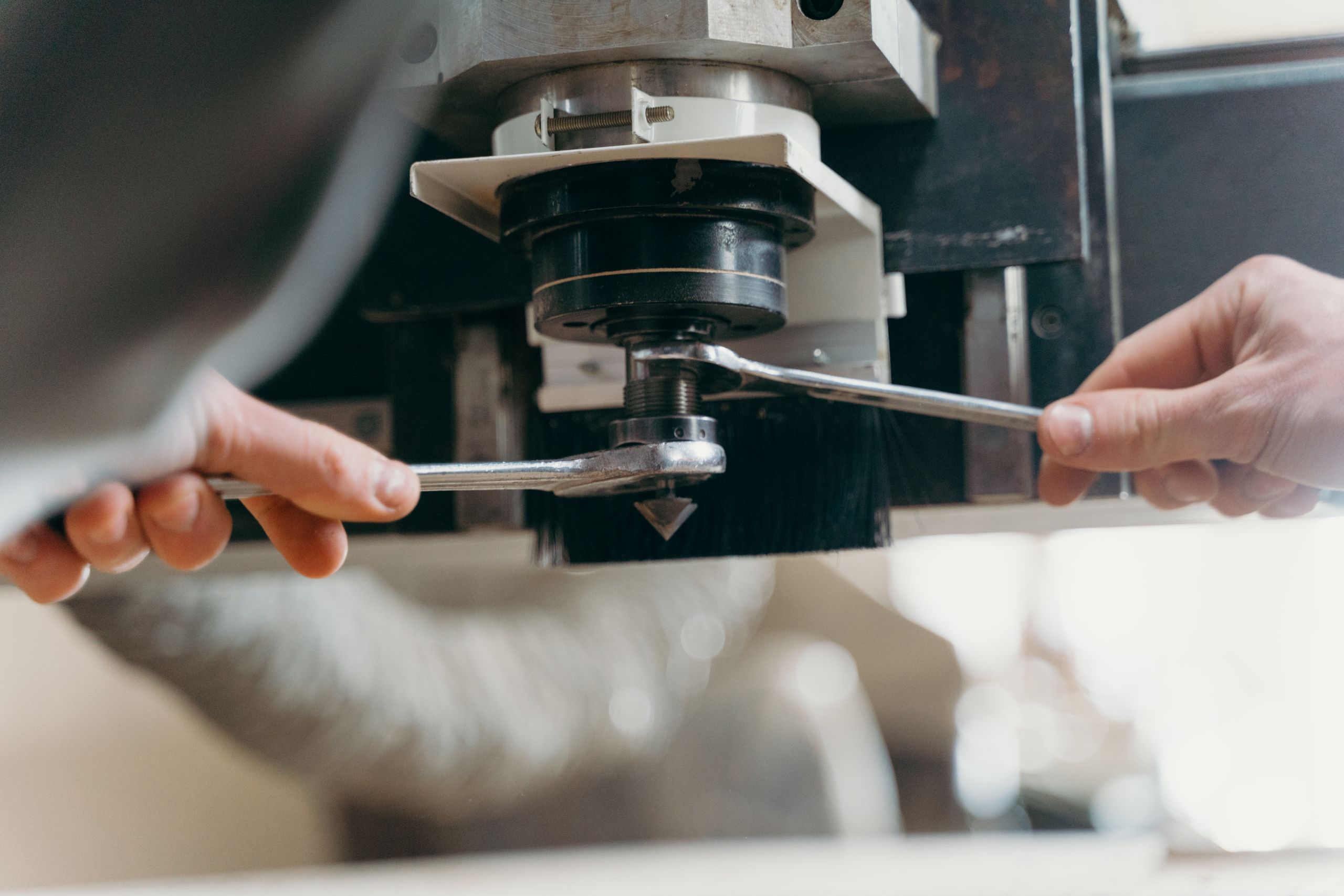
The Right-Hand vs Left-Hand Milling Cutter Guide requires a mechanical check before programming. Confirm that reverse spindle operation is permitted, the coolant and chip system works in that direction, and no threaded component can loosen. Clean the taper, collet, nut, and shank; use adequate clamping length; minimize projection; and measure runout near the cutting end.
Feeds, Speeds, and Entry Strategy
Use the tool supplier’s cutting data for the exact material and cutter. Calculate feed from chip load, tooth count, and spindle speed. Confirm that the programmed rotation and feed create the intended cutting action before the tool touches the part. Use a suitable ramp, helix, or side entry only when the tool is designed for it; not every cutter can plunge.
Workholding and Axial Force
Helix direction can push the workpiece toward the table or pull it upward. Neither behavior replaces clamps or vacuum capacity. Support thin stock, position clamps outside the toolpath, and verify that the expected cutting force cannot lift, shift, or rotate the part. A secure setup also reduces chatter and dimensional error.
Common Setup Errors
- Tool rubs instead of cutting: stop and verify cutting hand, spindle direction, edge condition, and programmed feed.
- Chips pack in the cut: correct chip-flow direction, extraction, coolant delivery, or engagement.
- Part lifts: improve workholding and verify helix-generated axial force.
- Holder loosens: stop immediately and use a holder approved for the selected rotation.
- Heavy chatter: reduce projection, check runout, improve support, and adjust engagement within supplier limits.
Safety Checklist
- Confirm rotation before installing or touching off the tool.
- Keep the enclosure and guards closed during the test run.
- Stay within tool, spindle, and holder speed ratings.
- Stop the spindle before measuring or clearing chips.
- Replace damaged cutters and worn holders.
- Follow the machine manual and applicable OSHA machine-guarding guidance.
How to Order the Correct Cutter
Send the supplier the machine model, spindle rotation capability, holder type, workpiece material, toolpath direction, feature dimensions, chip-flow objective, coolant method, and finish requirement. Request a dimensioned drawing with the cutting-hand convention, rotation arrow, helix direction, maximum speed, and recommended cutting data. See JeeFoo CNC cutting tool solutions for related cutter options.
Frequently Asked Questions
Is a right-hand helix always a right-hand cutting tool?
Not necessarily. Terminology and viewing direction vary. Use the manufacturer’s drawing, rotation arrow, and cutting-hand definition.
Can I run any milling cutter backward?
No. A cutter must rotate in its approved cutting direction, and the spindle, holder, coolant system, and program must support that direction.
Which hand gives a better finish?
Finish depends on material, edge geometry, runout, toolpath, rigidity, cutting data, and chip control. Use the Right-Hand vs Left-Hand Milling Cutter Guide to select the hand that matches the complete setup.
Final Recommendation
Never choose rotation by assumption. Match the supplier’s cutting-hand convention to the spindle, holder, chip-flow goal, and workholding, then verify the program with a protected test. This Right-Hand vs Left-Hand Milling Cutter Guide helps organize that check before production begins.

发表回复
要发表评论,您必须先登录。