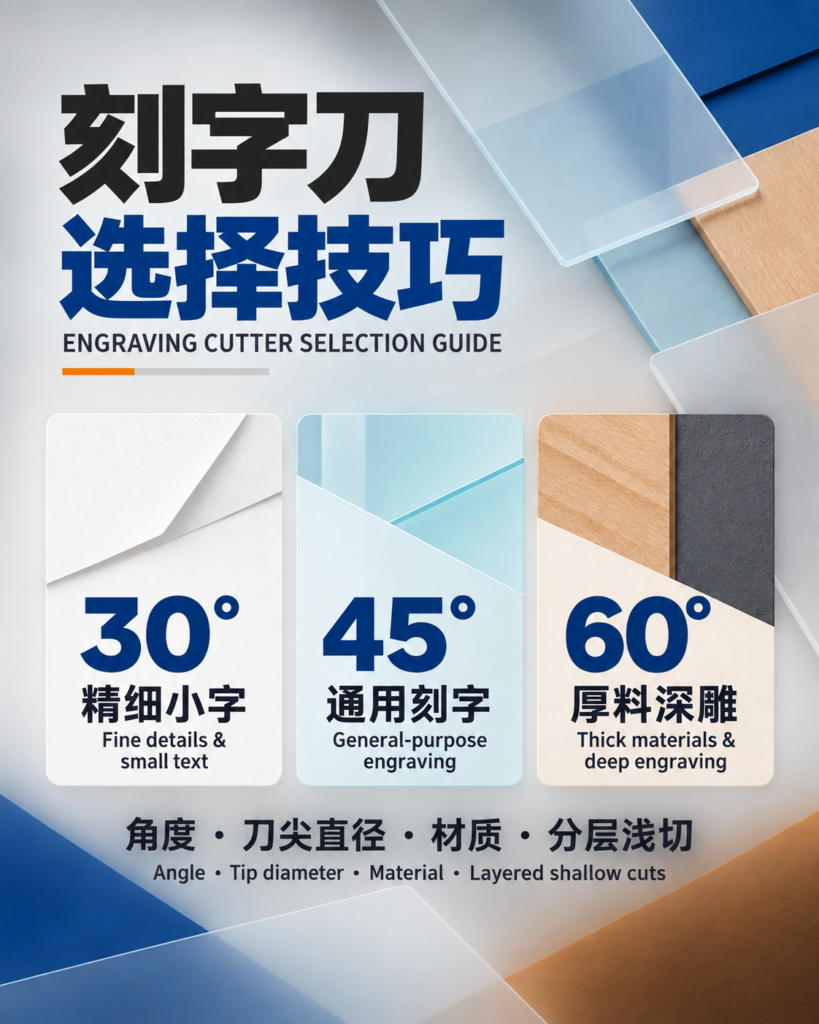
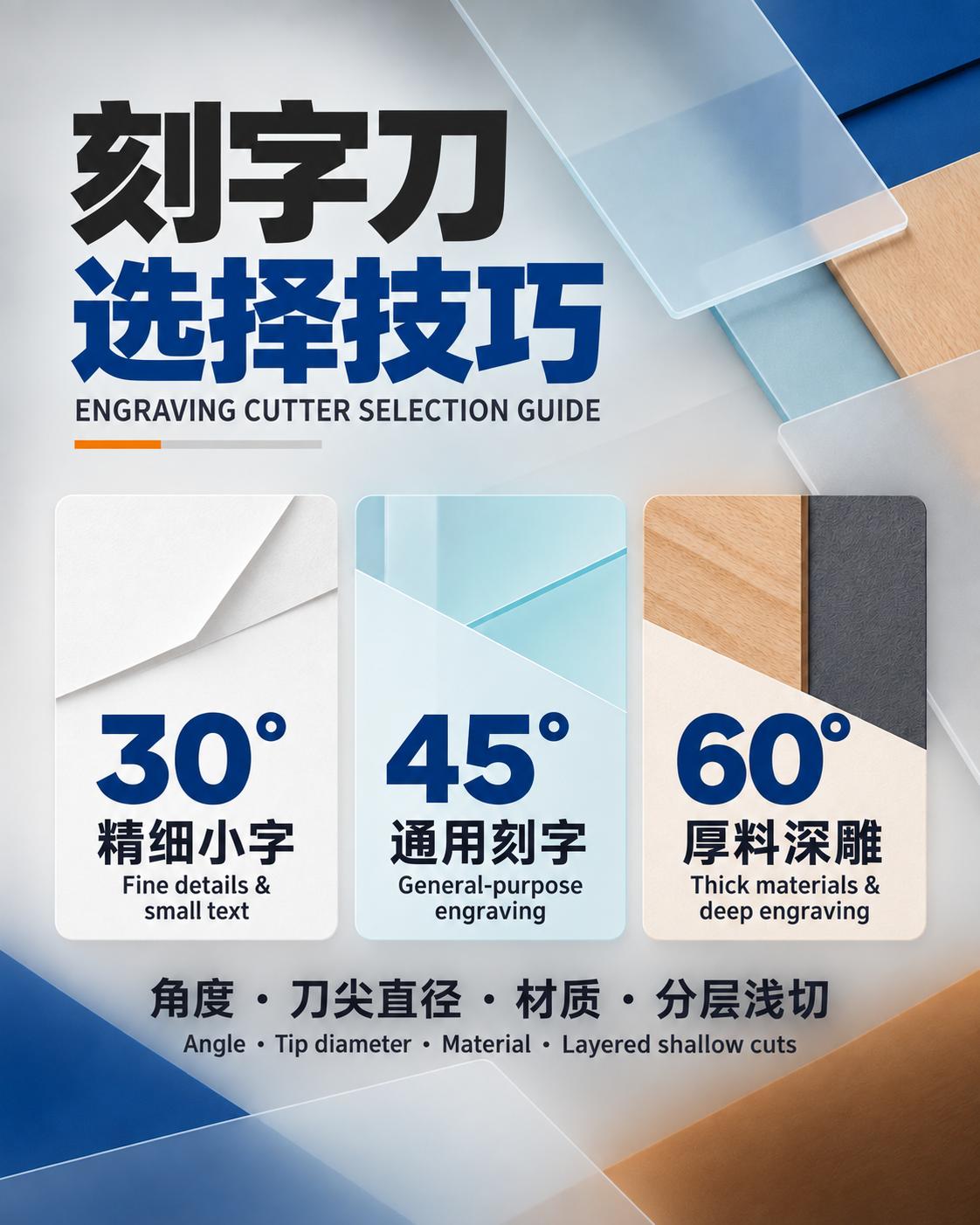
The effectiveness of engraving homework depends on the reasonable selection of engraving knives. Choosing the right knife can not only improve engraving accuracy and ensure the beauty of the finished product, but also reduce problems such as breakage and burrs, and extend the service life of the knife. By mastering simple selection techniques, one can adapt to different materials and engraving requirements, and adapt to various scenarios such as daily engraving and advertising engraving.
Angle is the core basis for selecting engraving knives. 30 °, 45 °, and 60 ° blades are commonly used for cutting stickers, car stickers, and films. Among them, the 45 ° blade is a universal version that balances sharpness and durability, suitable for ordinary adhesive stickers and conventional engraving operations. The 30 ° sharp tip is suitable for carving fine small characters and intricate patterns, but the tip is fragile and easily breakable. The 60 ° blade tip is thick and sturdy, suitable for hard materials such as thick film and cardboard. The disadvantage is that the engraved lines are thicker and not suitable for fine creation. Numerical control carving knives are commonly used in 60 ° and 90 ° specifications, with small angles selected for intaglio engraving of small characters and large angles selected for deep engraving of large characters.
The tip diameter and tool material are equally crucial. Fine micro characters and small logos are suitable for 0.1 to 0.4 millimeter fine blade tips. For regular advertising engraving, a 0.3 to 0.4 millimeter blade tip is sufficient. For large characters and stone carving, a thicker blade tip of 0.5 millimeters or more is required to enhance tool rigidity. In terms of material, the overall tungsten steel knife is wear-resistant and durable, suitable for most commonly used materials such as acrylic, wood, PVC, etc., and is the first choice for daily use. The diamond cutter has extremely high hardness and is specially designed for engraving hard materials such as stone and ceramics. It is suitable for gravestone and stone engraving. The high-speed steel cutter is only suitable for soft materials such as foam and cork.
Finally, it is necessary to avoid selection errors and not blindly pursue ultra-fine cutting tips. Thick material carving must be layered and shallow cut to avoid tool breakage. Before starting the formal assignment, it is necessary to test and debug the parameters in advance in order to achieve a smooth and even engraving effect, while balancing quality and efficiency.