
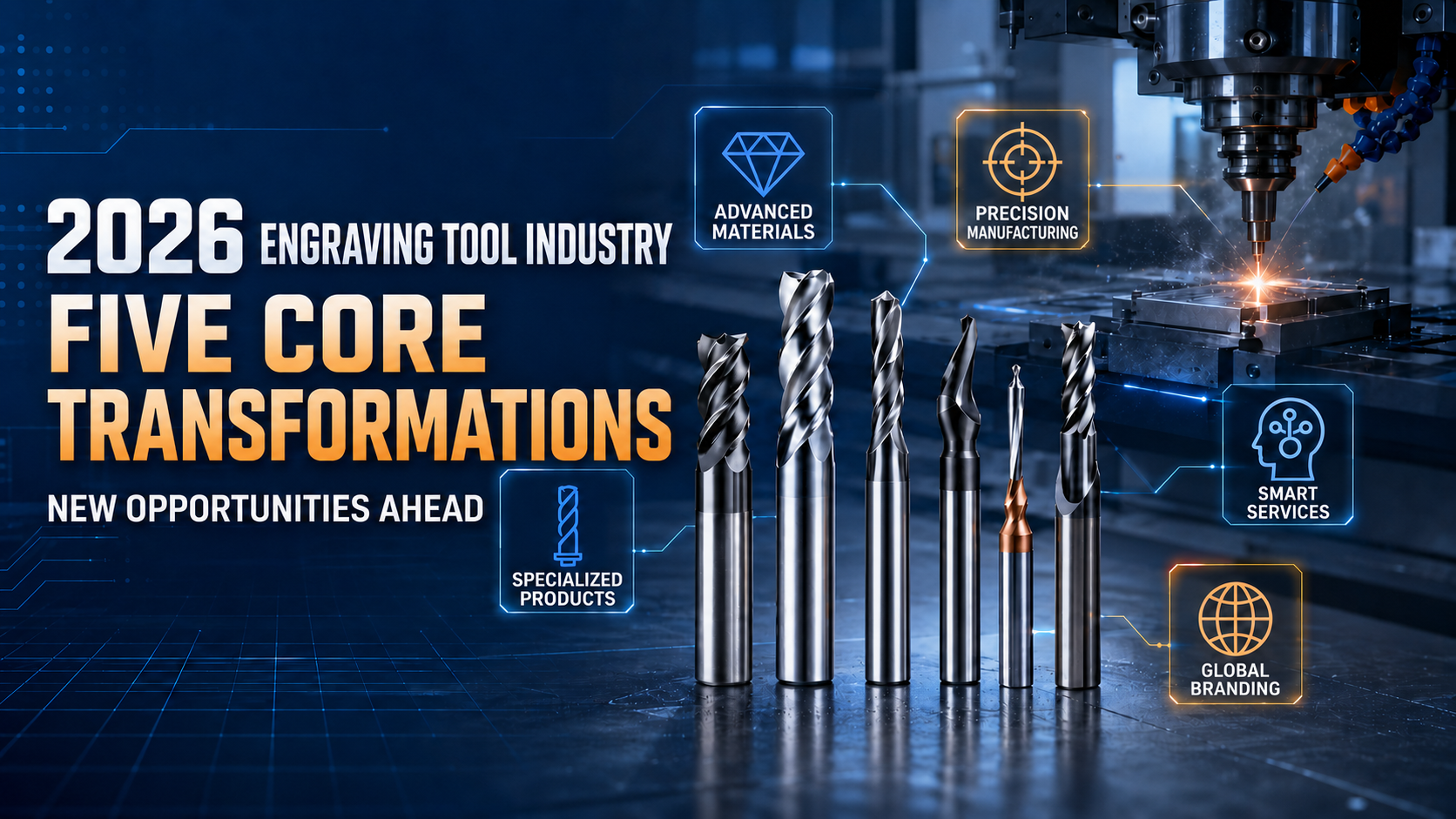
For a long time, the domestic carving tool industry has been deeply mired in homogenization and low price competition, with most manufacturers flocking to the general tool track, trading price for quantity, resulting in low industry profits and slow technological iteration. With the upgrading of downstream high-end industries, the implementation of new industry standards, and the acceleration of domestic substitution, the carving tool industry will officially bid farewell to the extensive development model and enter the golden cycle of structural upgrading in 2026. Relying on the five major changes of materials, processes, products, services, and going global, it will unlock new development opportunities.
Material superheating has become the core of industry transformation. At present, the market share of hard alloy carving knives is 63.4%, and PCD diamond superhard cutting tools account for 18.7%. High end cutting tools have become mainstream. Ultra fine grain cobalt free hard alloys and CVD diamond composite materials are widely used, greatly improving the wear resistance and impact resistance of cutting tools, adapting to complex processing scenarios such as rock plates and high-density sheets, completely eliminating the production capacity of low-end high-speed steel cutting tools, and ending the chaos of low-priced and high-volume production.
Manufacturing precision breaks the import monopoly. The femtosecond laser cold processing technology has achieved mass production, solving the problems of traditional processing thermal damage and insufficient accuracy. The precision of micro precision carving knives can reach micrometer level, suitable for high-end scenarios such as PCB and precision molds. The new version of the carving knife industry standard is mandatory, with 12 core precision indicators included in mandatory testing to standardize the industry’s production system.
At the same time, the three major changes in the industry continue to deepen: product specialization replaces generalization, and customized cutting tools for woodworking, slate, new energy, and semiconductors have become a necessity; Intelligent service implementation, widespread integration of tool monitoring, leasing, and customization services; Export branding is accelerating, with the export growth rate of domestically produced superhard cutting tools exceeding 20%, gradually getting rid of the low-end OEM label.
Overall, in 2026, the carving tool industry will completely bid farewell to low price internal friction, and a high-quality competitive pattern centered on technology, quality, and service will take shape. Domestic tools will usher in a broad space for substitution and increment.

.png)