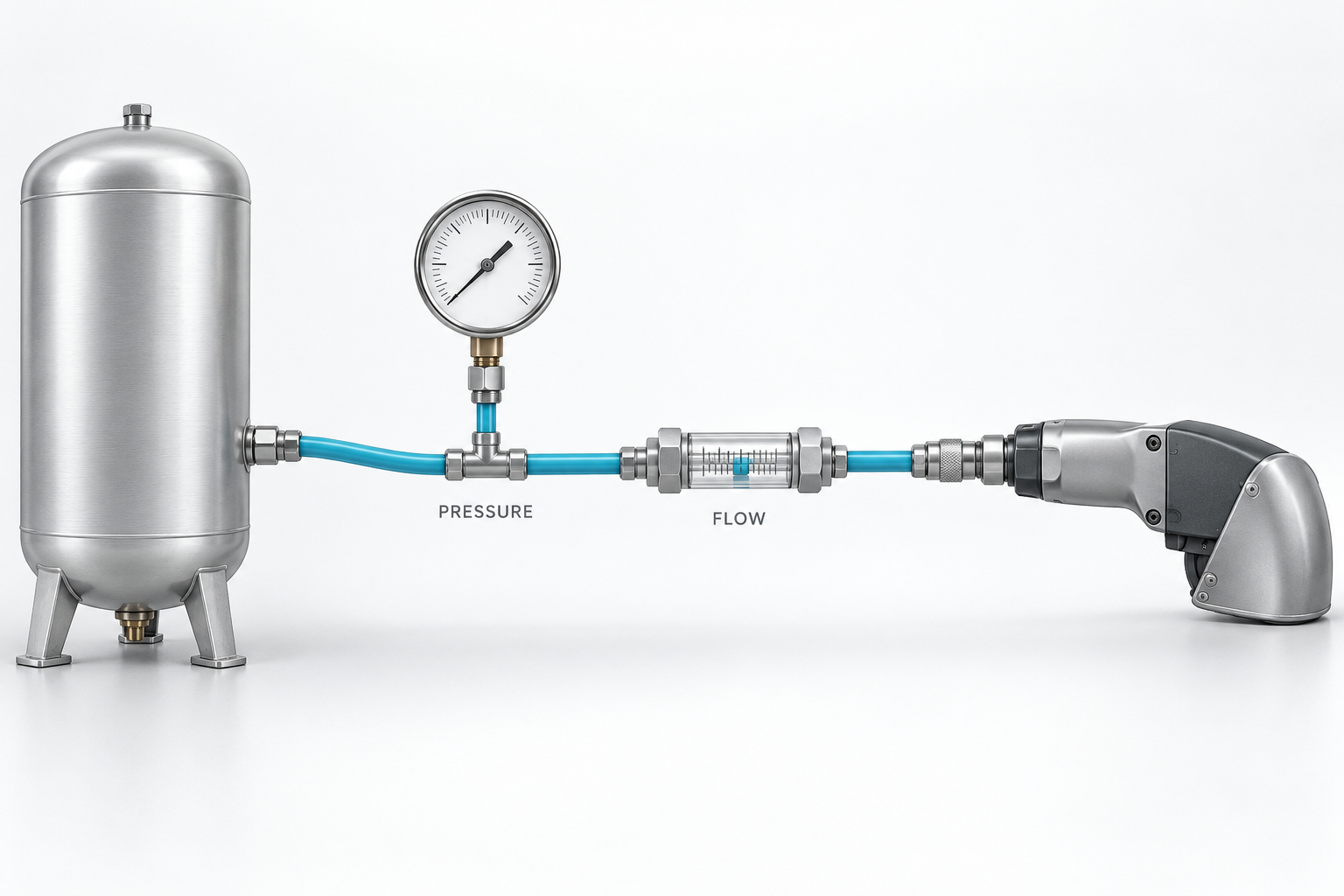
Pneumatic oscillating tools need both adequate air pressure and sufficient airflow at the specified operating conditions. A pressure gauge alone cannot establish whether the supply can sustain the tool. The distinction matters when a digital-cutting workshop adds an air-driven head: blade selection and compressed-air infrastructure are separate engineering decisions.
Why pneumatic oscillating tools have two supply requirements
Pressure describes the state of the compressed air; flow describes how much air passes through a section over time. Neither term means blade sharpness, cutting force at the material, or finished-edge quality. Treating a pressure setting as a complete performance specification skips the delivery system between the compressor and the head.
Zünd’s POT technical sheet dated November 2023 illustrates the distinction: it lists processing pressure and compressed-air consumption separately for its air-driven tool. Those entries belong to that manufacturer’s documented configuration, not to every oscillating head. This article deliberately does not turn them into a universal compressor size or an operating setting.
Pressure units and flow units answer different questions
Bar, MPa and psi are pressure units. Litres per minute and cubic feet per minute describe volumetric flow, but the reference conditions still matter. A number stated as free-air delivery is not automatically interchangeable with a volume measured inside a pressurized line. Preserve the manufacturer’s stated basis when comparing documents rather than copying only the largest number.
Parker’s pneumatic technical guidelines distinguish upstream pressure, downstream pressure and the pressure difference across a component. They also identify standard reference conditions for flow figures. The practical reading lesson is simple: a specification needs its units, reference basis and measurement location, not just a numerical value.
The air path belongs in the discussion
Imagine two descriptions of the same installation: “the compressor gauge looks correct” and “the required supply reaches the tool while it operates.” These are not equivalent statements. Pressure loss across components is part of the delivery problem. A workshop discussion that names only the compressor overlooks the route through treatment equipment, distribution piping and the final connection.
Atlas Copco’s compressor sizing guide treats pressure, airflow, duty cycle and air-quality requirements as distinct inputs. It also calls attention to pressure losses through air-treatment equipment. Its facility-level perspective complements the tool manufacturer’s specification; it does not replace it.
A better technical conversation, not a universal setting
For pneumatic oscillating tools, the useful handover is a shared definition of the demand. The equipment supplier identifies the exact head and applicable documentation. The compressed-air specialist interprets that requirement within the workshop’s distribution system and simultaneous loads. Production explains whether the intended work is intermittent or sustained. These responsibilities describe different parts of one problem.
For example, a purchasing message that says only “we have a compressor” leaves the operating condition unresolved. A more useful message names the installed head, supplies its current technical sheet, and asks which pressure and flow basis apply at the machine connection. That is an information example, not a report of a JEEFOO customer installation or a recommendation to modify an air system yourself.
Do not respond to an unexplained cutting symptom by raising pressure beyond the equipment limits. Supply assessment and any adjustments belong under the manufacturer’s instructions and competent technical supervision. Likewise, changing a blade does not establish that an air-delivery limitation has been resolved. Keep mechanical consumables, pneumatic supply and material behaviour distinct until evidence connects them.
Where this fits alongside plotter blades
The JEEFOO plotter-blade catalogue covers identified consumable families. It should not be read as a claim that the site supplies the pneumatic heads or compressors discussed here. A drag-blade listing and an air-driven oscillating module are not the same product simply because both participate in digital cutting.
The central conclusion is to read pneumatic oscillating tools as part of a supply system: pressure and flow must be understood together, but recorded separately. That distinction makes conversations about infrastructure more precise without inventing a universal cutting setting, a performance guarantee or a new product specification.