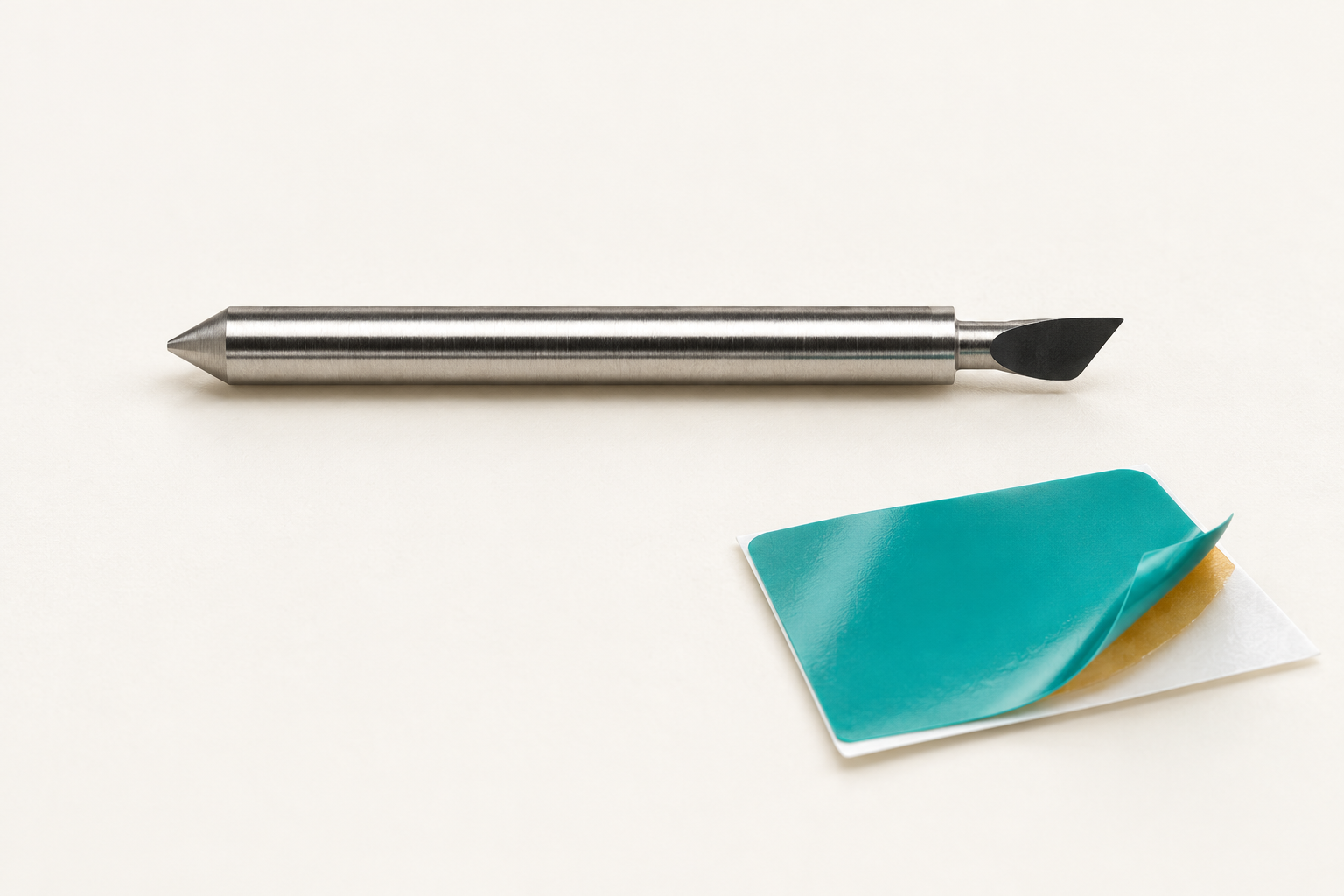
A vinyl cutting blade can separate a film while the adhesive beneath it subsequently touches and sticks to itself again. The result may look like an uncut line even though separation occurred. This possibility does not prove that every stubborn cut is complete: it explains why the appearance of a closed slit, by itself, cannot distinguish incomplete cutting from adhesive reattachment.
The blade passes through an interface, not just a colour
A coloured adhesive film is not a single homogeneous sheet. Its face film carries the visible shape, the adhesive provides attachment, and the release liner supports the construction before application. Those roles matter when interpreting a cut. A surface line tells us where the edge travelled; it does not, on its own, describe the condition of every layer underneath.
Think of two questions rather than one: what did the cutting edge separate, and what happened to the adjacent surfaces afterwards? They describe different events. Combining them into “the blade did not cut” can hide the material behaviour that occurred after the edge passed.
Separation and reattachment are different events
Roland DG’s SG2 cutting-conditions guidance specifically describes strong adhesive layers reattaching immediately after cutting. It cautions against excessive blade force when the prescribed cutting test, including peeling and the backing-paper traces, indicates a proper cut. This is guidance for the equipment and circumstances described, not a universal test standard for every plotter.
The important distinction is between an edge that never separated the intended material and surfaces that make contact again afterwards. A replacement vinyl cutting blade addresses the cutting component; it does not automatically explain what an adhesive does behind that component. Nor does this distinction justify declaring a difficult job acceptable without examining its actual result.
Why an adhesive is not a brittle spacer
In its white paper on bonding low-surface-energy materials, 3M describes pressure-sensitive adhesives as viscoelastic: they combine flow behaviour with elastic resistance. Its discussion explains how adhesive contact can develop over time. That supplies useful material vocabulary, but the document concerns bonding; it does not establish reattachment rates, cutting settings or performance for the vinyl on your machine.
This boundary matters. “Viscoelastic” is not a diagnosis of a particular roll, and a bonding example is not permission to heat a sheet or alter a cutter. The useful lesson is narrower: the adhesive layer should not be imagined as a rigid, permanently open gap merely because a sharp edge has passed through it.
Three observations that should not share one label
Actual incomplete separation means the intended cut has not been achieved. Reattachment concerns contact after separation. Adhesive or debris on the cutting tip is a third issue, involving the condition of the tool itself. Roland’s GS-24 cut-quality troubleshooting treats tip contamination among possible causes of poor cutting. It should not be renamed “reattachment” simply because both involve adhesive.
Keeping these descriptions separate makes a workshop discussion more precise without prescribing another sequence of settings. The question is not whether adhesive exists, but where it is and which event the evidence actually supports. Uncertainty should remain visible rather than becoming an unsupported verdict on blade sharpness.
Where the vinyl cutting blade fits
The JEEFOO 45-degree Roland-family blade listing provides an identified product family for an enquiry. It does not establish compatibility with the SG2 discussed above. Confirm the exact supplied reference and holder interface; an angle alone cannot identify every matching assembly. A vinyl cutting blade remains one part of a material-and-machine combination, not a promise of a particular adhesive response.
Conclusion: explain the interface before blaming the edge
A closed-looking cut is an observation, not a complete explanation. Distinguishing incomplete separation, adhesive reattachment and tip contamination gives the vinyl cutting blade a properly defined role. Follow the actual machine and material instructions when assessing the result, rather than converting an ambiguous slit into a reason for more force or an unnecessary replacement.